
Quick Summary
Core Solution: Resolving enterprise lead-to-account matching failures in Salesforce Enterprise by deploying automated domain-parsing algorithms and custom record-triggered flows.
Key Fix: Eliminating orphaned leads and duplicate records by establishing fuzzy matching rules, parent-child hierarchy linkages, and clean multi-touch attribution structures.
Strategic Takeaway: Leveraging advanced Apex and Flow automation to ensure seamless lead routing, protecting pipeline velocity, and accurately feeding b2b multi-touch attribution salesforce lead setup frameworks.
Resolving Lead-to-Account Matching Breakdowns in Enterprise Funnels
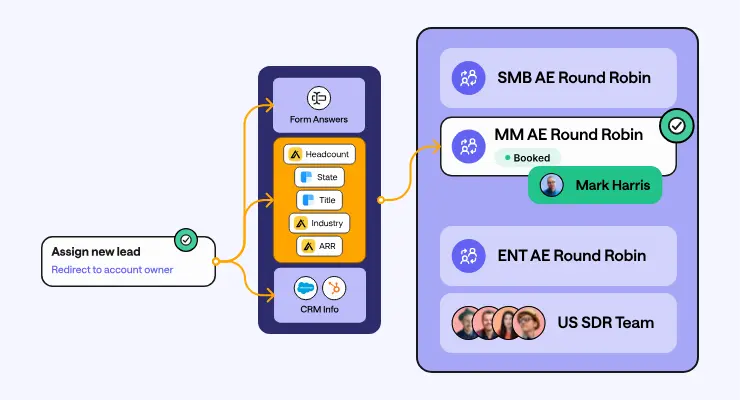
Direct Solution / Key Takeaway: When complex enterprise sales pipelines experience data fragmentation, CRM administrators must quickly learn how to fix salesforce lead to account matching errors to prevent revenue leakage. As a Lead CRM Architect, I regularly guide enterprise revenue operations teams who need to troubleshoot enterprise b2b lead routing salesforce queues, execute a precise salesforce duplicate lead account mapping fix, automate lead to account association salesforce flow builders, and implement a robust b2b multi touch attribution salesforce lead setup. By replacing native lead assignment rules with intelligent domain-parsing and fuzzy matching logic, you can automatically link inbound prospects to existing accounts before sales development reps ever touch the record.
When multinational B2B enterprises scale their marketing and inbound acquisition engines, maintaining clean data structures across accounts, contacts, leads, and opportunities becomes an immense challenge. As a Lead CRM Architect, Senior RevOps Consultant, and Technical Solutions Engineer, I frequently assist enterprise organizations running Salesforce Enterprise, HubSpot Custom Objects, and Dynamics 365 Dataverse who discover that their inbound leads fail to match existing parent accounts. When thousands of new leads flood your CRM daily from disparate web forms, webinars, and third-party syndication networks, poor data hygiene causes severe routing delays, duplicate record proliferation, and broken attribution reporting.
A common mistake I see enterprise CRM administrators make is relying entirely on native Salesforce Lead Assignment Rules or basic email domain matching without accounting for subsidiary domains, free email providers, or multi-entity account hierarchies. When a prospect submits a form using a corporate email domain that differs from the parent account’s registered web domain, or when multiple operating entities share overlapping naming conventions, the system treats the lead as completely new. This creates redundant account records, splits historical engagement data across disconnected objects, and distorts executive pipeline forecasts.
As an expert consultant, I guide CRM administrators, RevOps leaders, and technical solutions engineers through the deep technical configuration, custom flow architecture, duplicate management protocols, and attribution reporting required to resolve lead-to-account matching errors permanently. This comprehensive guide outlines the exact administrative navigation paths, formula syntax, JSON payload structures, and compliance control validation rules necessary to bulletproof your enterprise revenue operations ecosystem.
The Architecture of Account-Based Lead Routing and Domain Matching
Before configuring automated matching logic, you must understand why native Salesforce architectures struggle with complex enterprise domain matching and how to bridge the gap.
The Limitations of Standard Lead-to-Account Matching Rules
Standard Salesforce matching rules excel at identifying exact duplicate contacts or accounts based on strict criteria like email or company name, but they fall short when reconciling multi-touch B2B inbound leads:
-
The Domain Discrepancy Problem: Global enterprises often acquire subsidiary companies operating under distinct web domains (e.g.,
brandx.comacquired byparentcorp.com). If an inbound lead registers withuser@brandx.com, standard domain matching rules fail to associate the lead with the parent accountparentcorp.comunless cross-reference tables are explicitly defined. -
Free Email Provider Pollution: Inbound submissions originating from generic email domains (
gmail.com,outlook.com) cannot be matched via domain parsing alone, requiring secondary heuristics based on company name string matching and IP geo-location data. -
The Impact on Revenue Attribution: When leads remain unassociated from target accounts, marketing analytics engines cannot aggregate touchpoints across the buying committee, breaking your b2b multi touch attribution salesforce lead setup and rendering ROI calculations inaccurate.
Step-by-Step Guide: Fix Salesforce Lead-to-Account Matching Errors
Resolving persistent matching failures requires a structured forensic investigation of your inbound lead ingestion pathways and object relationship schemas.
Step 1: Identifying Orphaned Leads and Unmatched Accounts
To audit your current database for unmatched inbound leads:
-
Log into your Salesforce Enterprise instance with System Administrator credentials and navigate to Setup > Object Manager > Lead > Fields & Relationships.
-
Create a custom checkbox field named
Matched to Existing Account(Matched_to_Existing_Account__c) to flag successfully processed records. -
Navigate to the Reports tab in Salesforce Lightning and create a new custom tabular report joining Leads with custom criteria where
Matched to Existing Accountequals false andConvertedequals false. -
Export this report to analyze domain patterns, identifying recurring corporate suffixes or subsidiary naming variations that bypass your current routing logic.
Step 2: Configuring Fuzzy Matching and Custom Domain Parsing Rules
To upgrade your matching capabilities beyond exact string comparisons:
-
Navigate to Setup > Duplicate Management > Matching Rules and create a custom matching rule on the Account object targeting
WebsiteandNamewith fuzzy matching options enabled. -
In tandem with duplicate rules, construct custom formula fields on the Lead object to strip leading protocols (
https://,http://,www.) from web URLs, normalizing company domains into clean string values for backend comparison. -
Save your rules and activate them through the Duplicate Rules setup menu to ensure real-time evaluation upon lead creation.
How to Troubleshoot Enterprise B2B Lead Routing in Salesforce
When sales development representatives report missed leads or delayed routing, you must execute a systematic troubleshooting protocol across your assignment queues and territory management structures.
Resolving Queue Bottlenecks and Territory Assignment Conflicts
Enterprise routing failures often occur when assignment rules conflict with automated territory management or custom Apex triggers:
-
Rule Evaluation Order: Salesforce evaluates assignment rules strictly in numerical order. If a high-priority rule routes a lead to a generic queue before domain-matching automation can evaluate the account hierarchy, the match is lost.
-
Territory Management Overrides: Enterprise Deployments utilizing Enterprise Territory Management (ETM) must ensure that lead-to-account assignment flows execute prior to territory evaluation rules.
Pages: 1 2

